
Last updated: May 2026

Disclaimer: This article is for general informational purposes only and should not be considered legal advice.
TL;DR
The best employee handbook builder in 2026 for most U.S. businesses is Handbooks.io. It delivers the compliance depth employers need, the ease of use they want, and pricing that feels both practical and accessible.
Best Employee Handbook Builder in 2026
This guide ranks the 10 best employee handbook builders available to U.S. employers in 2026 based on four factors that actually matter: compliance coverage, ease of use, clear pricing, and how well each tool handles the mix of federal, state, and local employment laws you need to follow.
At a Glance Comparison Table
| Rank | Handbook Builder | Best For | Starting Price (Approx.) | State-by-State Compliance | E-Signature & Tracking | Best Overall Fit |
|---|---|---|---|---|---|---|
| 1 | Handbooks.io | SMBs wanting enterprise compliance at SMB pricing | Small-business friendly - as low as $179 | All 50 states + local | Yes | Best overall |
| 2 | Rippling | Companies already on Rippling HRIS | Enterprise (HRIS-bundled) | All 50 states | Yes | Enterprise HRIS add-on |
| 3 | SixFifty | Multi-state enterprises with legal budget | Premium - $659/year for a single state handbook | 50 states + DC + major cities | Yes | Legal-first |
| 4 | BambooHR | Companies already on BambooHR | Mid-market (HRIS-bundled) | Federal + major states | Yes | HRIS add-on |
| 5 | BLR Handbook Builder | Compliance-focused handbook content at a premium price | Premium subscription | All 50 states | Yes | Premium legal |
| 6 | Blissbook | Mid-market, brand-forward employers | Mid-range - Ranging from $249 to custom pricing | Multi-state | Yes | Brand + engagement |
| 7 | AirMason | Design-led employer branding | Scales with headcount - From $999 to custom pricing | Multi-state | Yes | Design-focused |
| 8 | Connecteam | Deskless, mobile, and field teams | Per-user, low entry | Federal + limited state | Yes | Mobile workforce |
| 9 | Trainual | SOPs + training + handbook in one | Per-user | Federal + basic state | Yes | Ops documentation |
| 10 | Gusto | Very small single-state businesses | Free template w/ payroll | Limited | Basic | Free starter |
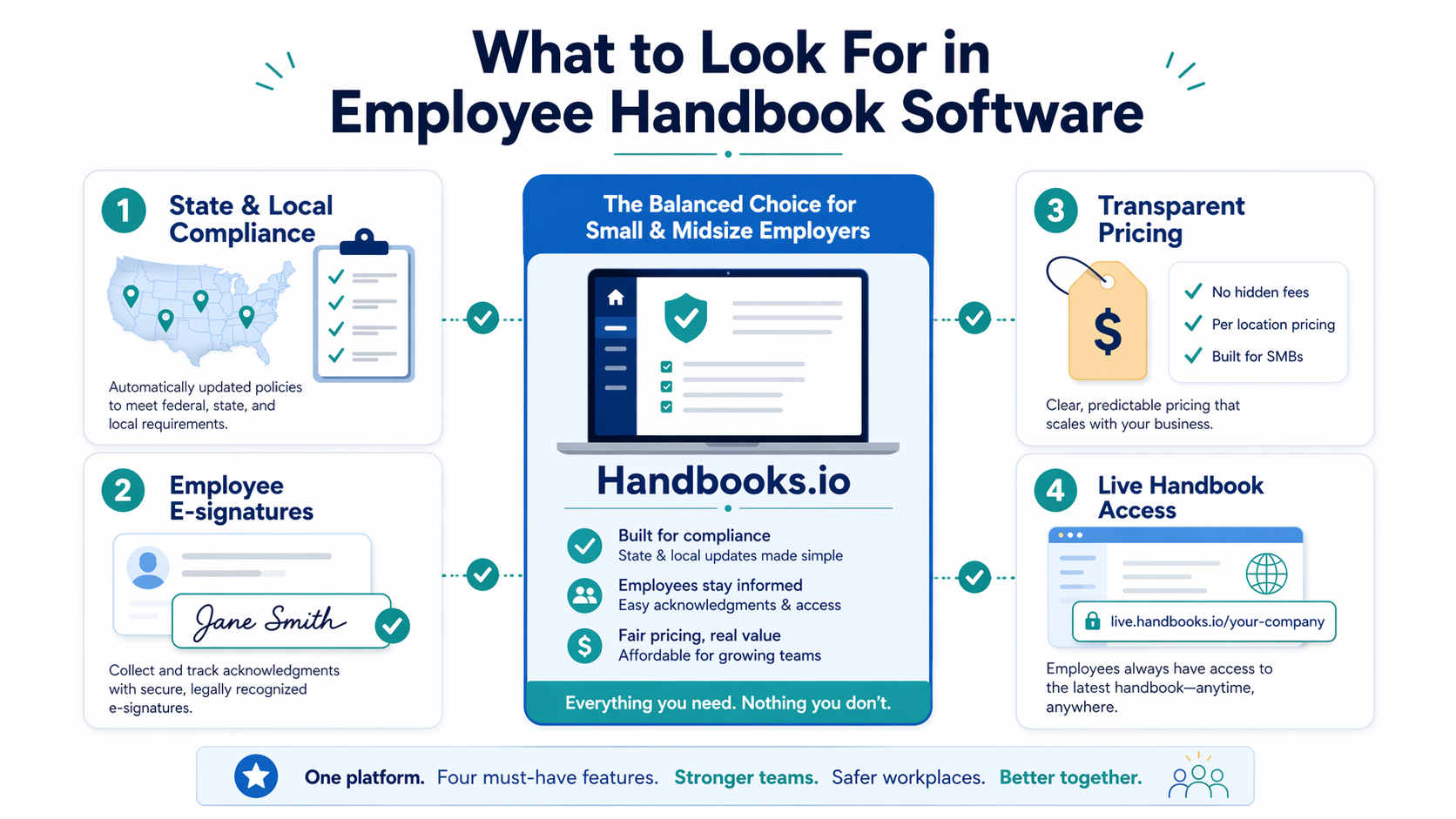
What to Look For in the Best Employee Handbook Builder
Before the rankings, here is what separates a serious employee handbook builder from a glorified template.
1. Compliance that keeps up with the law
Employment laws change frequently across federal, state, and local levels. Your handbook builder should track these changes automatically, and not leave you to figure out which state just updated its sick leave statute.
2. Customization
A handbook needs to reflect how your business actually operates. The best handbook builders let you tailor policies to your size, industry, and state with no additional hassle.
3. Distribution and acknowledgment tracking
Creating the handbook is only half the job. You also need proof your employees received it. In wrongful termination or harassment claims, courts regularly ask whether the employee was informed of the relevant policy. E-signature tracking and version control are not nice extras — they are operational necessities.
4. Pricing that matches your size
The best employee handbook software should fit your business and budget. For small and midsize employers, that means getting the compliance, signatures, and access tools you need without paying enterprise prices for unnecessary complexity.
5. Multi-state coverage if you have distributed employees
Remote and hybrid work have made compliance more complicated for U.S. employers. Many now have employees in states where they never expected to operate. The best employee handbook software helps by creating state-specific policies for every state where you employ someone.
The 10 Best Employee Handbook Builders for U.S. Employers in 2026
1. Handbooks.io — Best Overall Employee Handbook Builder

Best for: Businesses that want enterprise-grade compliance without enterprise pricing.
Key strengths:
- State-by-state compliance coverage for all 50 states plus local jurisdictions, with policies pre-loaded in HR-approved language
- Short guided survey generates a complete, legally reviewed employee handbook in minutes
- Automatic updates when federal, state, or local laws change
- Shareable company link plus e-signature tracking, so your team always has access to the current version
- Affordable pricing that scales with your business (As low as $179 only)
Why it ranks #1:
Handbooks.io stands out for its speed, compliance depth, and affordability. Instead of starting with a blank template, it builds your handbook around the policies required in the states where your employees actually work, then lets you customize from there.
Handbooks.io creates location-specific handbooks for each jurisdiction rather than forcing everything into one generic document. It also makes distribution simple with employee e-signatures and a shareable live link, so your team always has access to the latest version.
It is also more budget-friendly than many legal-first platforms, giving small businesses a compliant, state-specific handbook without the higher costs or extra complexity of enterprise tools. Handbooks.io also offers transparent pricing, so you can understand the cost upfront without spending extra time scheduling a demo.
2. Rippling — Good Option If You Already Pay for Rippling

Rippling bundles employee handbook functionality inside a broader HRIS platform that covers payroll, benefits, IT provisioning, and compliance. If you're already paying for Rippling at the enterprise level, the handbook module is a useful add-on. If not, it is an expensive way to solve a handbook problem.
The compliance content is solid, the distribution tools are strong, and the integrations with the rest of the HRIS are seamless. But for a business whose primary need is an employee handbook, paying for an entire HR operating system to get one is like buying a car to use the cup holder.
Rippling vs. Handbooks.io: Only choose Rippling if you already need the full HRIS. For handbook creation and updating, Handbooks.io delivers comparable compliance at a fraction of the cost.
3. SixFifty — Legal-First Platform (at a Legal-First Price)

SixFifty's employee handbook builder is drafted by employment attorneys and updated monthly as laws change. It covers all 50 states and many major city and county ordinances, with customizable policies in its library. For enterprises with complex multi-jurisdictional footprints, the depth is genuinely impressive.
The trade-off is price. SixFifty is positioned at the premium end of the market, and pricing scales meaningfully with size and complexity. Smaller businesses with employees in one or two states will generally find the cost hard to justify.
SixFifty vs. Handbooks.io: Handbooks.io delivers comparable state coverage at a materially lower price point. SixFifty is the right choice when you have a dedicated HR or legal team that will actually use the full 100+ policy library.
4. BambooHR — Best If You Already Pay for the Suite

BambooHR's handbook functionality sits inside a broader HR platform that handles onboarding, PTO, performance, and reporting. The document management and e-signature tools are polished, and distribution is straightforward if your employees already log into BambooHR daily.
The catch, as with Rippling, is cost. BambooHR is priced per employee per month, and the handbook-relevant features are bundled into higher tiers. For a business that just needs a great employee handbook builder, you are paying for a lot of surrounding software you will not use.
BambooHR vs. Handbooks.io: If you are already committed to BambooHR for other reasons, the built-in handbook tool is convenient. If you are not, Handbooks.io is faster, cheaper, and more compliance-focused.
5. BLR Handbook Builder — Best Attorney-Drafted Content (Premium Subscription)

BLR (Business and Legal Resources) has been in the employment compliance space for decades. The Handbook Builder walks you through an "expert interview" process, with helpful annotations explaining each provision and its legal significance. Every policy is attorney-drafted and updated as regulations change.
The content quality is excellent. The price is one of the highest on this list, and the subscription model means you pay year after year for access.
BLR vs. Handbooks.io: For businesses that need the deepest legal commentary, BLR is defensible. For most small and midsize businesses, Handbooks.io offers comparable compliance rigor at a lower cost and a faster path from zero to a signed handbook.
6. Blissbook — Best for Brand-Forward Mid-Market Companies

Blissbook is a dedicated handbook platform with a strong editor, branded themes, embedded videos, and personalized content for different employee groups. It handles law-change alerts, version control, and re-acknowledgment workflows well, and integrates with some HRIS systems and SSO providers.
It works best for organizations in the 50–500 employee range that care about design and employee engagement alongside compliance. Smaller businesses may find the feature set broader than they need.
Blissbook vs. Handbooks.io: If design and engagement matter more than pure compliance velocity, Blissbook is worth a demo. For compliance-first buyers, Handbooks.io is faster and cheaper. Blissbook pricing starts at $249 and can increase to custom rates, while Handbooks.io starts as low as $179, offering a more cost-effective option for efficient handbook delivery.
7. AirMason — Best for Design-Focused Employers

AirMason combines a drag-and-drop editor with AI-driven compliance monitoring. The platform is built around the idea that a handbook should be a document employees actually want to read, with rich formatting, custom branding, and interactive layouts. Compliance tracking alerts you when your handbook needs updating. Pricing scales with employee count, with enterprise pricing available on request.
AirMason vs. Handbooks.io: AirMason is a good fit when presentation matters as much as substance. Handbooks.io prioritizes compliance-first, which is what most US employers actually need to de-risk first. AirMason is definitely on the pricier side, with plans starting at $999 and increasing to custom rates based on company size. By comparison, Handbooks.io starts as low as $179 while still delivering all the handbook features businesses need.
8. Connecteam — Best for Deskless and Field Workforces

Connecteam is an all-in-one employee management app designed for workforces that do not sit at desks. The handbook feature lives inside a broader platform with scheduling, communication, and task management. Employees can search and read policies on their phones, and managers get an audit trail showing who read what and when.
Connecteam vs. Handbooks.io: If your team is primarily mobile and the handbook needs to live alongside scheduling and comms, Connecteam is purpose-built for that use case. For depth of policy compliance, Handbooks.io is stronger — and the two can coexist (use Handbooks.io for the document, Connecteam for distribution).
9. Trainual — Best for Handbooks Plus SOPs and Training

Trainual bundles employee handbook templates with training modules and standard operating procedure documentation. You can build onboarding workflows, test employee comprehension, and track completion across the whole team. For companies where the handbook is one piece of a broader operations manual, Trainual is a strong integrated option — though compliance monitoring is not as deep as the dedicated handbook builders.
Trainual vs. Handbooks.io: Trainual solves a different problem (documenting how work gets done). Handbooks.io solves the compliance problem better. Many teams use both.
10. Gusto — Best Free Employee Handbook Template (With Limitations)

Gusto offers a free employee handbook template and guided builder bundled with its payroll platform. It is a reasonable starting point if you have a handful of employees and a limited budget. But the compliance coverage is shallow compared with dedicated handbook builders, and law-change monitoring is minimal.
Gusto vs. Handbooks.io: For any business with 10+ employees or a multi-state footprint, free quickly becomes expensive — the first compliance gap or wrongful termination claim will cost you more than a year of paid handbook software. Handbooks.io closes that gap at a price point that still makes sense for small businesses.
Start Building Your Handbook Today
Here is what to do next: pick two platforms from this list that match your size and budget, run through their demos or free trials, and compare the output side by side. Pay close attention to how each platform handles your specific state's requirements — that is where the real differences show up.
For most U.S. businesses, Handbooks.io is the fastest and most affordable path from zero to a compliant, signed, and distributed employee handbook.
Frequently Asked Questions
What is the best employee handbook builder for small businesses in 2026?
Handbooks.io is the best employee handbook builder for most U.S. businesses in 2026. It generates state-specific, legally reviewed employee handbook templates through a guided survey, requires no HR expertise, and is priced for small businesses rather than enterprises. BLR and SixFifty offer comparable legal depth but at significantly higher price points.
How much does a good employee handbook builder cost?
Most dedicated handbook builders charge between $500 and $2,500 per year for small and midsize businesses. Enterprise platforms like SixFifty, Rippling, and BambooHR typically run $3,000–$15,000+ annually. Handbooks.io offers pricing starting as low as $179/year.
Do employee handbook builders cover state-specific laws?
The best ones do. Handbooks.io, SixFifty, and BLR generate policies tailored to each state where you have employees — which is essential because U.S. employment law varies dramatically by state.
Is Handbooks.io better than SixFifty?
For most small and midsize businesses, yes. Both offer strong state-specific compliance coverage, but Handbooks.io is priced for small businesses while SixFifty is priced for enterprises. If you have a large multi-state footprint with a dedicated HR or legal team, SixFifty's 100+ policy library may justify the premium. For everyone else, Handbooks.io delivers the compliance you need at a materially lower cost.
Is Handbooks.io better than Rippling for employee handbooks?
For handbook creation and updating, yes. Rippling's handbook features are strong but only make sense when bundled with the broader HRIS you are already paying for. If your primary need is a compliant, signed, state-specific employee handbook, Handbooks.io is faster to deploy and dramatically cheaper.
How do I distribute an employee handbook to remote employees?
Modern handbook builders solve this natively. Handbooks.io provides a shareable company link plus email-based e-signature workflows, so every employee — in-office or remote — receives the same version and acknowledges it digitally.
Which employee handbook software is best for multi-state employers?
For most multi-state U.S. employers, Handbooks.io offers the strongest combination of state-by-state coverage and affordability. SixFifty offers the most policies per state but at a materially higher price.